The Best Wordle Starting Words in British English — A Data Analysis
Published 13 May 2026 · about 7 min read
Your first guess in Wordle very often decides whether you finish in four turns or scrape through in six. So which word should you actually open with? We analysed all 985 British English Wordle answers in our archive and worked out which five-letter starter tells you the most about the remaining grid after row one.
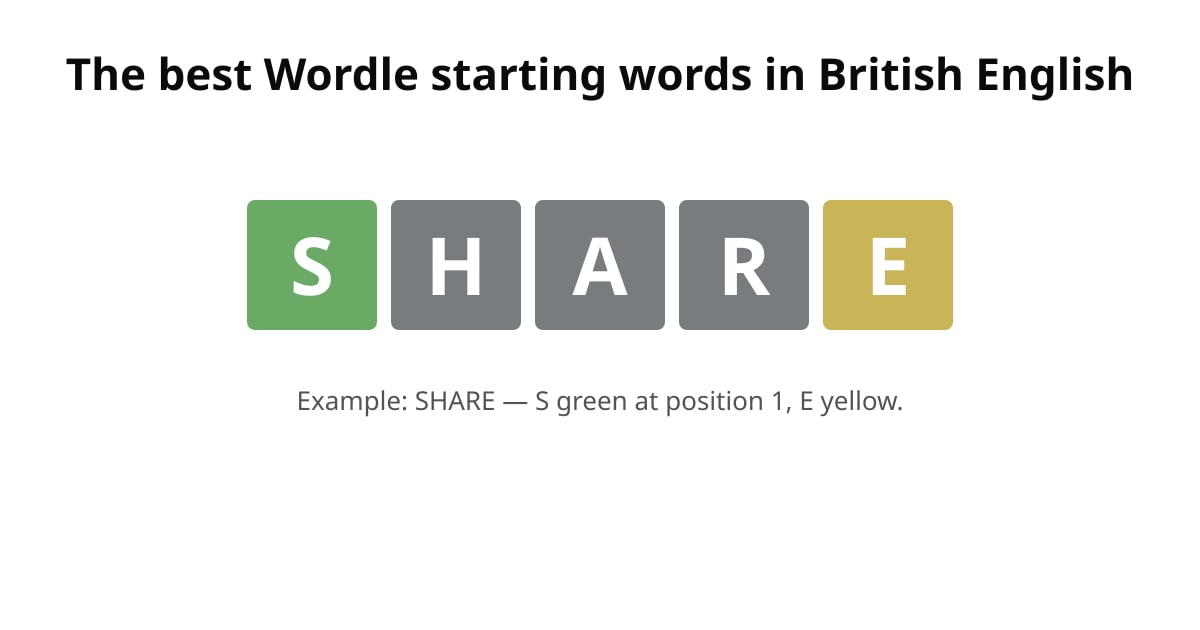
The method: letter frequency and positional value
A good starting word does two things at once. It contains common letters, and it puts those letters in the positions where they actually appear. E is the most common letter in the Wordle answer set overall – but it turns up overwhelmingly at positions 4 and 5. Putting an E in position 1 simply wastes it: the letter is rare there, and you learn nothing about where it really lives at the same time.
Our model rates every possible five-letter starter using a positional score: how well do its letters match the actual per-position frequencies in 985 British English Wordle answers? The higher the score, the more the word tells you on average after a single guess.
The most common letters in British English Wordle
First, the raw distribution. Which letters turn up most often anywhere in a British English Wordle answer?
| Rank | Letter | Count | Share |
|---|---|---|---|
| 1 | E | 479 | 9.7% |
| 2 | A | 431 | 8.8% |
| 3 | R | 398 | 8.1% |
| 4 | T | 319 | 6.5% |
| 5 | I | 314 | 6.4% |
| 6 | S | 301 | 6.1% |
| 7 | O | 294 | 6.0% |
| 8 | L | 261 | 5.3% |
| 9 | N | 254 | 5.2% |
| 10 | C | 227 | 4.6% |
E leads at 9.7%, followed by A (8.8%) and R (8.1%). The procession that follows – I, O, T, S, N, L, C – matches what most fluent English readers feel in their bones. What overall frequency tucks away, though, is where those letters land. That is where openings live or die.
Why position is the whole game
Overall frequency only takes you so far. What matters is where each letter sits inside a five-letter word. The positional breakdown reveals sharp, exploitable patterns:
- Position 1: S dominates at 17.3% – more than one in six British English Wordle answers begins with S. C (9.3%), B (8.7%) and P (6.6%) follow on behind.
- Position 2: A leads at 13.2%, with O (13.2%) close on its heels. A consonant in position 2 is a real outlier; a vowel there is about the safest bet on the board.
- Position 3: Still vowel-heavy: A (17.5%), I (13.8%), O (9.8%). English five-letter words have a clear soft spot for a vowel in the middle.
- Position 4: E surges – 12.9% of answers carry an E here.
- Position 5: E dominates at 20.7%, followed by T (12.1%). More than one in five Wordle answers ends in E.
That distribution is precisely why S-_-_-_-E is such a powerful skeleton for a British English opener. You hit the single most likely starting letter, leave the vowels free for positions 2 and 3, and close on the dominant ending letter. The only question left is what to slot into positions 2, 3 and 4.
The best starters by positional score
Here are the top ten British English starters our model ranks highest:
| Rank | Word | Score |
|---|---|---|
| 1 | SLATE | 1 |
| 2 | SHARE | 0.997 |
| 3 | CRANE | 0.979 |
| 4 | SLICE | 0.974 |
| 5 | SHINE | 0.963 |
| 6 | BRACE | 0.952 |
| 7 | STARE | 0.942 |
| 8 | CRATE | 0.935 |
| 9 | SNARE | 0.935 |
| 10 | SAUCE | 0.929 |
SLATE tops the list at 1. SHARE (0.997) and CRANE (0.979) follow within a hair of it. Notice how the entire top five hugs the same S-_-_-_-E shape – each one swapping middle letters that cover different common consonants and vowels (H, A, R, L, I, N, U, C).
That is the real insight: there is no single magic opener. The top ten are functionally interchangeable for the first round. Choose the one whose middle letters you find easiest to recall and reason from.
A practical recommendation
Optimal and comfortable are not always the same thing. SHARE and SLATE are both common, easily recalled words that sit at the top of the rankings, and either one makes a thoroughly solid permanent opener. If you would rather front-load the vowels, SAUCE (score 0.942) packs three of them (A, U, E) into a single guess. CRANE (score 0.979) is the consonant-heavier favourite that plenty of analytics-minded solvers already swear by.
What matters far more than choosing rank 1 over rank 5 is committing to one starter. Players who use the same opener every day develop a feel for which patterns the grid eliminates after row one, and can plan rows two and three around that. The magic isn't in any specific word. It is in never switching.
Test your starter on today's Wordle — daily challenge, hourly mode and unlimited play.
Play Wordle NowThis article is based on an automatic analysis of all 985 British English Wordle answers in the DailyWordGames.co.uk archive. The data is recomputed on every site build.