Nearly Half of Every Wordsearch Hides Its Words Backwards
Published 13 May 2026 · about 6 min read
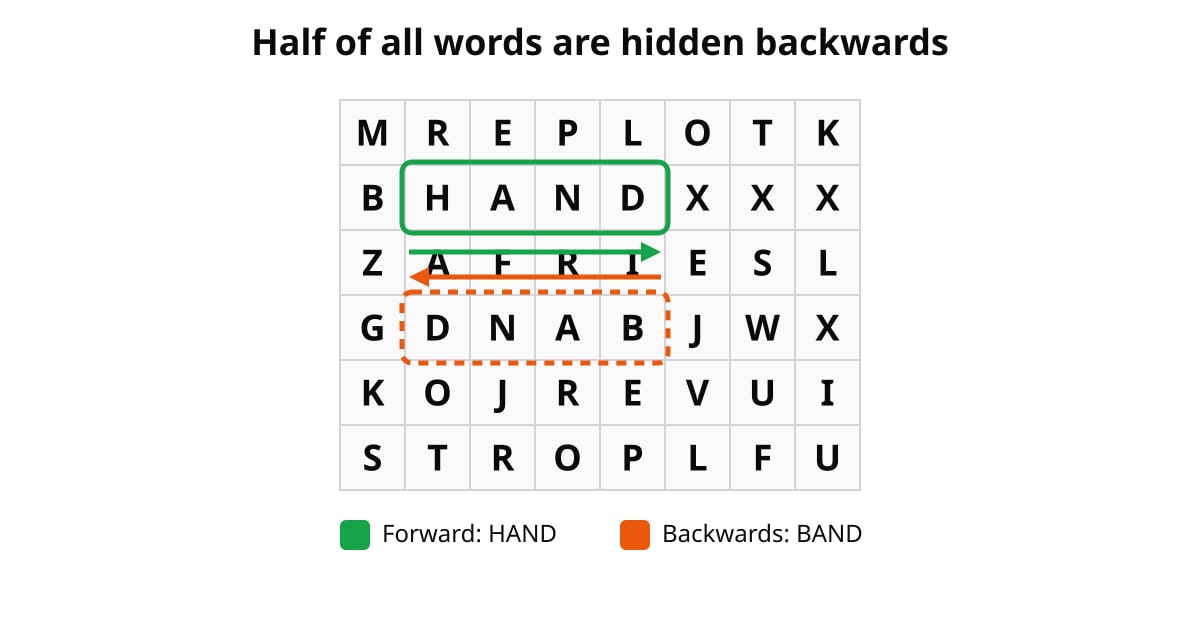
You know the feeling. You sweep the grid three times, give up on a word, and then catch sight of it on the fourth pass – running the wrong way round. There is a tidy explanation for that. Across all 731 British English wordsearch puzzles in our archive, 49.8% of hidden words are placed in a direction you have to read backwards. Practically every other word. And that is the half your eyes keep gliding past.
What the data shows
Every word in a wordsearch sits in one of eight directions: horizontal left-to-right or right-to-left, vertical top-down or bottom-up, plus four diagonals. From a reader's point of view, four of those eight directions are backwards. So when a generator distributes words evenly across the compass, you end up with roughly half of them running "the wrong way" – and that is exactly what we measured.
Across the full archive, 49.8% of placed words sit in a direction that asks you to read the letters in reverse. Mathematically, no great surprise. Behaviourally, this is where most of your solving time disappears: you spot the forward-running words quickly, then grind through the rest of the clue list wondering where on earth the missing ones have got to.
How often each direction shows up
Grouped along the three main axes, the distribution looks like this:
- Horizontal (left/right): 30.8%
- Vertical (up/down): 30.7%
- Diagonal: 38.5%
Drilling down to the eight compass directions, East (5,289 placements) and South (5,267) sit a whisker ahead of their reversed counterparts West (5,219) and North (5,212). The four diagonals – NE (3,294), SE (3,273), SW (3,278) and NW (3,296) – together account for roughly a quarter of all placements. Not rare. Just easy to miss.
Why your brain is worse at reading backwards
Reading runs almost automatically from left to right. Years of practice have trained your visual system to recognise letter strings as whole words in that direction, with no conscious effort. Reverse the letters and the automatic pattern-matcher simply stops firing. You have to consciously flip the sequence in your head before it locks into a familiar shape – and across twenty hidden words, those extra seconds add up to a noticeably slower solve.
There is also a scanning bias to contend with. Your gaze tends to sweep the grid the same way it reads a page: top-left to bottom-right. Forward-running words happily sit along that natural path. Backwards words run across the grain of it.
What word lengths actually appear
Across all puzzles, the most common word length is 5 letters (10,542 placements), followed by 6 letters (9,169). The average hidden word is 5.5 letters long.
That matters for your strategy. Shorter words are harder to spot because their letter patterns blend more easily into the surrounding grid and can appear "readable" in several directions by accident. Longer words – eight letters and up – are easier to lock onto because their shape is more distinctive, even when running backwards.
How to find backwards words faster
A handful of concrete techniques that genuinely help:
- Scan from the end of the word. Pick a word from the clue list and think about its last letter, not its first. For HOUSE, look for an E that is followed by an S. If you find that pair, check whether a U, O and H continue the line.
- Use common endings as starting letters. English words often end in -ing, -tion, -ed or -er. Reversed, those become gni-, noit-, de- and re- at the start of a backwards line. A "gn" or "noi" pair sitting somewhere in the grid is a strong hint.
- Watch for double letters. Double consonants like LL, TT or SS and double vowels like EE and OO stand out in any direction. They are a quick way to anchor a candidate word regardless of orientation.
- Rare letters first. Q, X, Z and J appear rarely in English, so they jump out of the grid. Find which clue words contain them and search outward from those letters in all eight directions.
- Scan systematically. When intuition fails, drop the freeform gaze and sweep the grid row by row – once left-to-right, then once right-to-left. It feels plodding. It catches every backwards word that intuition missed.
What to take away
The 49.8% rule really only changes one reflex: what you do when a word refuses to appear. Instead of writing it off as "not in the grid", have a go at a second pass looking for it in reverse. In nearly half of all cases, that is exactly where it has been hiding.
Test your eye on today's word search — some words are written backwards.
Play Word Search NowThis article is based on an automatic analysis of all 731 British English wordsearch puzzles in the DailyWordGames.co.uk archive. The data is recomputed on every site build.